
"The Dollar Is Crashing!" — Exchange Rates in Plain English, and Why the Headline Usually Comes Late
Exchange rates come up when you plan a trip abroad, buy a foreign stock, or see a scary headline about the dollar. Most people never get a clear explanation, so the numbers feel random and a little intimidating. They aren't. This guide covers four things: how to read a quote without getting it backwards, what actually moves currencies, what a strong or weak dollar means for your stocks, and a simple rule for when to change money for a trip.
1. What an Exchange Rate Actually Is
Think of each currency as a product with a price tag. When you change $100 into euros at the airport, you are buying euros and paying in dollars. The exchange rate is the price. Like any price, it goes up when more people want the product and down when fewer do.
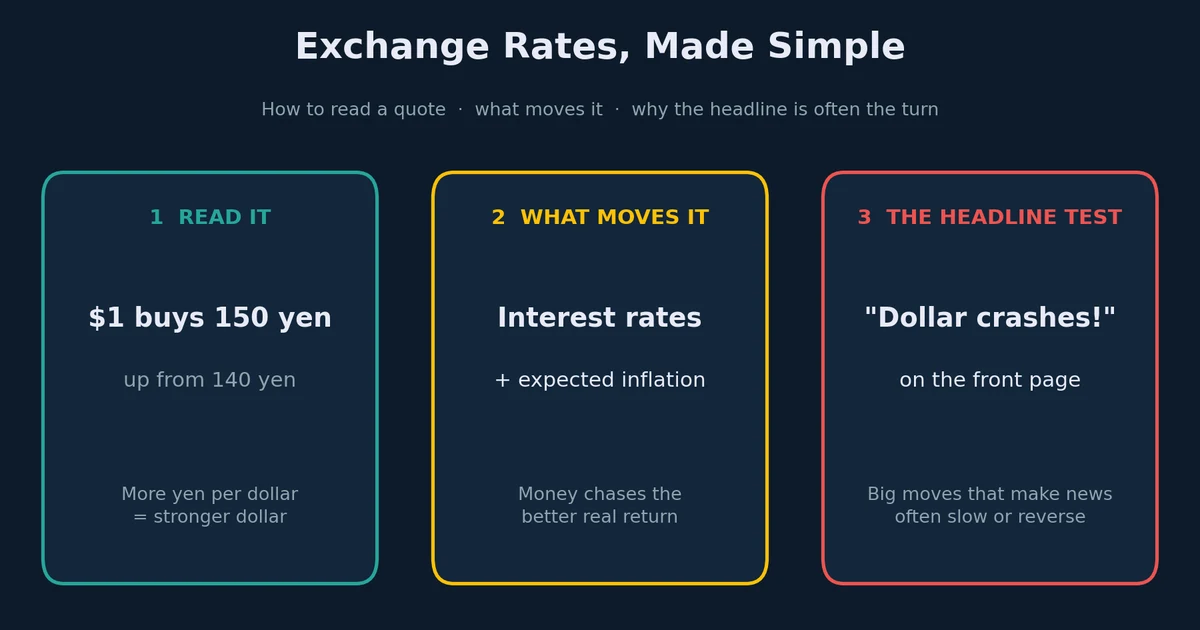
The confusing part is that the same rate can be written two ways. "1 dollar = 150 yen" and "1 yen = 0.0067 dollars" describe exactly the same thing. Headlines often say "the rate went up" without saying which way round they mean, so you can't tell whether that is good or bad news for you.
The fix is to always translate the number into one plain question: how much of the other currency does one dollar buy? If the answer gets bigger, the dollar got stronger. If it gets smaller, the dollar got weaker.
| How it's quoted | What it means | If the number goes up… |
|---|---|---|
| USD/JPY = 150 | $1 buys 150 Japanese yen | Dollar stronger (your dollar buys more yen) |
| USD/CAD = 1.37 | $1 buys 1.37 Canadian dollars | Dollar stronger |
| EUR/USD = 1.10 | €1 costs $1.10 | Dollar weaker (a euro now costs you more) |
| GBP/USD = 1.30 | £1 costs $1.30 | Dollar weaker |
Notice the trap in the bottom two rows. The euro and the British pound are usually quoted the other way round, as "dollars per euro," so a rising number there means a weaker dollar. That one convention causes most of the confusion about currencies. Whenever you see a quote, flip it into "one dollar buys…" and the direction becomes obvious. (All the numbers in this guide are round illustrations, not today's rates.)
2. "The Dollar" in the News Usually Means the Dollar Index
When a newscast says "the dollar fell today," it rarely means against one currency. It usually means the U.S. Dollar Index (often shown as DXY), which measures the dollar against a basket of six major currencies at once. Think of it as an average.
The basket is far from evenly weighted. The euro makes up about 58% of it, the Japanese yen about 14%, the British pound about 12%, the Canadian dollar about 9%, and the Swedish krona and Swiss franc the rest. So "the dollar index fell" mostly means "the dollar fell against the euro."
That matters because the currency you care about may be doing something quite different. The dollar can weaken against the euro while strengthening against the yen in the same month. If you're planning a trip to Mexico or buying a Korean stock fund, neither the peso nor the won is in the index at all. Check the pair you actually use, not the headline average.
3. What Makes a Currency Go Up or Down
Here's a fair question: the U.S. is the world's largest economy, so shouldn't the dollar always be strong? It isn't. Its value against other currencies swings by 10–20% or more over a few years. Two forces do most of the pushing.
Force one: interest rates. An interest rate is the price of borrowing money, and it's also what money earns while it sits in a bank or a government bond. Big investors move huge sums to wherever they earn more. Suppose a dollar savings account pays 4% a year and a yen account pays 1%. Money will tend to leave yen and move into dollars to earn the extra 3%. To do that, investors have to buy dollars, and that buying pushes the dollar up. Money follows the best return, quickly and without sentiment.
Force two: inflation, or more precisely, expected inflation. If the dollar always pays more interest, why doesn't it rise forever? Because interest is only half the story. Inflation means prices rise, which is the same thing as each dollar buying less. Go back to the example and add inflation. If U.S. prices are expected to rise 3% a year and Japanese prices 0%, the comparison changes:
| Interest earned | Expected inflation | What you really gain | |
|---|---|---|---|
| Dollar account | 4% | 3% | about 1% |
| Yen account | 1% | 0% | about 1% |
Measured by what your money can actually buy (economists call this the "real" return), the two accounts come out about even. The higher interest rate was mostly compensation for faster-rising prices. So it's the difference in real returns between two countries that moves the exchange rate, not the headline interest rate alone. And because what matters is what people expect inflation to be, currencies often move on a single inflation report or central-bank speech, before anything has actually changed.
There's also a built-in brake. When a currency gets very strong, that country's goods become expensive for everyone else. A strong dollar makes American exports pricier abroad and foreign vacations cheap for Americans. Over time, people buy fewer of the expensive country's goods and more of the cheap country's goods, and that shift slowly pulls the rate back. Currencies swing, sometimes a lot, but they tend not to run in one direction forever.
4. What a Strong or Weak Dollar Means for Your Stocks
If you own foreign stocks, you also own the foreign currency. When you buy a European stock or an international fund, you are really making two bets: one on the companies and one on the currency they're priced in. Here's a simple example. Your European fund rises 10% in euros over a year. But during that year the euro falls 10% against the dollar. Converted back into dollars, your gain is roughly wiped out: 1.10 × 0.90 = 0.99, a loss of about 1%. The reverse happens too. A weakening dollar quietly adds to your foreign returns. That's why two investors holding the "same" international fund can report different returns: one is looking at the price in the local currency, the other at the price in dollars.
U.S. companies that sell abroad feel it too. Many large American companies earn a big share of their sales overseas. Say a company sells €100 million of goods in Europe. If one euro is worth $1.10, that converts to $110 million on its U.S. income statement. If the dollar strengthens until one euro is worth $1.00, the same sales report as only $100 million, nearly a 10% drop with no change in the actual business. So in general:
| When the dollar… | Usually helps | Usually hurts |
|---|---|---|
| Strengthens | Companies that buy goods abroad and sell at home (retailers, importers); Americans traveling abroad | U.S. exporters and multinationals (overseas sales shrink when converted to dollars); returns on foreign stocks, measured in dollars |
| Weakens | U.S. exporters and multinationals; returns on foreign stocks, measured in dollars | Importers; Americans traveling abroad |
5. The Headline Test: A Simple Rule for When to Change Money
So far this has been about understanding. Here is something practical. Suppose you're going to Japan next spring, six months away, and expect to spend about $3,000 there. Should you change your dollars into yen now or wait? A 10% move in the rate, which is not unusual over six months, is a $300 difference on that trip. That's real money.
The honest answer is that nobody can reliably predict where the yen will be in six months. That leaves two sensible approaches, depending on what the news looks like.
When nobody is talking about the currency: don't try to guess. Most of the time exchange rates are quiet, and any forecast is basically a coin flip. The simplest approach is to split the purchase. Change a third now, a third in a couple of months, and the last third before you leave. You won't get the best possible rate, but you won't get the worst one either, and you won't spend six months anxiously watching the rate. This is the same reasoning behind dollar-cost averaging into stocks, applied to travel money.
When the currency is on the front page: consider doing the opposite of what the headline makes you feel. Most people ignore exchange rates. For a currency move to make the front page of the newspaper, the top of the evening news, or every finance video on YouTube, it has to be unusually large. Unusually large moves have usually already happened, and many of them slow down or partly reverse soon after the panic peaks. When the headlines read "the yen collapses to a multi-decade low" and everyone says it will keep falling, your instinct says wait for it to fall further. That's often the moment to lock in at least part of your purchase. The same logic applies in reverse: when "the dollar is crashing" is everywhere, the dollar is rarely at its best value to sell.
Treat this as a rule of thumb, not a law. Sometimes a front-page move keeps going for months. That's another reason to combine the two approaches: when headlines are screaming, act on a portion rather than everything. The real value of the headline test is that it stops you from making the most common mistake, which is selling or waiting at the moment of peak fear because a dramatic story made it feel certain.
Key Takeaways
An exchange rate is just the price of one currency in another, and the easiest way to read any quote is to ask how much one dollar buys. More means a stronger dollar, less means a weaker one. Watch out for the euro and the pound, which are quoted the other way round. "The dollar" in the news is usually the dollar index, which is mostly the dollar against the euro, so check the currency you actually use.
Currencies move mainly on the gap in interest rates between countries, adjusted for how fast each country's prices are expected to rise. Expensive currencies tend to correct over time, so no currency stays strong forever, not even the dollar. A strong dollar hurts U.S. exporters and your foreign holdings (in dollar terms) and helps importers and travelers. Building a stock strategy on a currency forecast rarely pays.
For everyday money decisions, two habits do most of the work. When the rate is quiet, split your purchases over time instead of guessing. When a currency move is front-page news, remember that the headline usually arrives late, and don't let it rush you into acting at the extreme.
The free simulator lets you replay monthly investing in the S&P 500 next to a dollar-priced South Korea fund (EWY), whose returns combine Korean stocks with the won-dollar rate. Comparing the two shows how much a currency can add to, or subtract from, the ride.
Open the Simulator →
Disclosure: Educational content only, published October 2026. This is not investment, tax, or currency-trading advice, or a recommendation to buy or sell any security or currency. All exchange rates, interest rates, and inflation figures in this article are rounded illustrations, not current market data. Dollar index weights are approximate. No rule of thumb reliably predicts currency movements.