
NVIDIA Doubled Revenue to $96 Billion — and Answered the AI Bubble Question With "100% Confidence"
The largest company on Earth just grew revenue 106% year over year. The stock's first reaction was to fall — and the most important part of the night wasn't a number at all.
Numbers That Shouldn't Be Possible at This Size
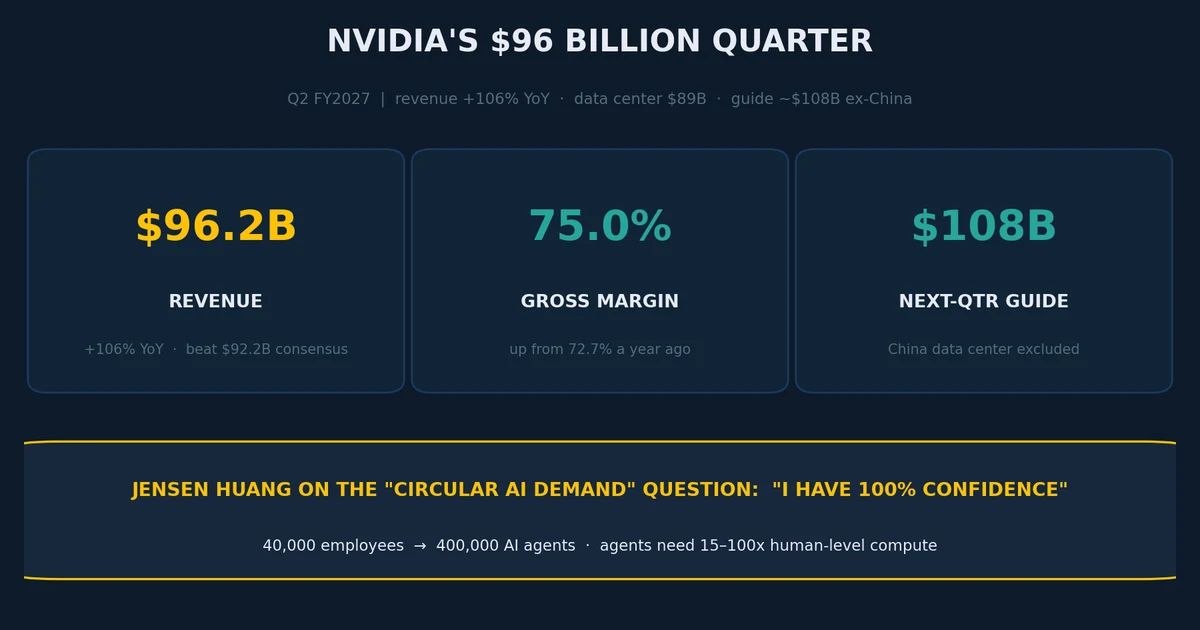
Start with what actually printed. Revenue of $96.2 billion beat the roughly $92 billion consensus and about doubled from $46.7 billion a year ago. Data center did $89 billion of that — up 128% year over year — meaning the segment that was the entire company a year ago is now larger than the entire company was a year ago. Gross margin came in at 75.0%, up from 72.7% in the same quarter last year, and non-GAAP earnings reached $2.22 per share, roughly doubling year over year.
Why does the doubling matter more than the beat? Because of the base it's happening on. Small companies double; the most valuable company in the world is not supposed to. A 106% growth rate at a multi-trillion-dollar market cap has no real precedent, and it's why every earnings season the market hunts for the one number that cracks — this time, a guided gross margin around 74% was about the only candidate. The tape showed exactly that tension: the stock dipped modestly right after the release, then recovered to trade up around 4–5% as the call went on.
| Metric (Q2 FY2027) | Result | Reference | The read |
|---|---|---|---|
| Total revenue | $96.2B (+106% YoY) | Consensus ~$92.2B | A doubling quarter at record scale |
| Data center | $89B (+128% YoY) | Consensus ~$85B | Almost the whole company — and the fastest-growing part |
| Gross margin | 75.0% | 72.7% a year ago | Pricing power intact despite memory cost inflation |
| Non-GAAP EPS | $2.22 | ~2x YoY | Growth is dropping through to the bottom line |
| Q3 guide | ~$108B (±2%) | Excludes China data center | ~89% YoY growth with a wildcard held in reserve |
The Quiet Shift: Half the Business Isn't Big Tech Anymore
The most investable sentence on the call had nothing to do with the headline beat. Management disclosed that hyperscale customers — the handful of giant cloud platforms — accounted for $48.7 billion of data center revenue, while everyone else (AI clouds, sovereign projects, enterprises, edge deployments) contributed $40.3 billion. In other words, the non-Big-Tech half of demand has essentially caught up, and Huang noted that about half the business is growing about 100% a year.
Why that matters: the bear case has always leaned on customer concentration — a few hyperscalers who could cut orders at once, and who are all designing their own chips precisely to buy less from NVIDIA. A sovereign fund, a regional AI cloud, or a mid-size enterprise has no silicon team and no realistic prospect of building one. They buy the full product at full price, which is exactly the margin point management made: the broader the customer base gets, the less bargaining power sits on the other side of the table. Concentration risk falling and margin support rising is a rare combination in the same disclosure.
From Selling a Chip to Selling the Whole AI Factory
Huang spent much of the call on an idea that explains how the revenue keeps compounding even as unit demand matures: NVIDIA's share of each data center's budget keeps rising. In the Hopper era, the company captured something like $18 billion per gigawatt of AI data center buildout — essentially the GPUs. Each generation since has pulled more of the system into NVIDIA's box: networking, CPUs, memory integration, the full architecture. Same factory, bigger slice.
The new Vera Rubin platform is the sharpest version of the pitch. The claimed advantage over the current GB300 generation isn't a single speed number — it depends on load. At relaxed request rates the gap is roughly 2x; push harder and it's 10x; at the extreme concurrency that swarms of AI agents generate, the older architecture simply saturates while Rubin keeps scaling, which is how "30x" claims — and Huang's suggestion that the real-world gap could be far larger — get generated. Microsoft's CEO publicly posting a photo of his first Vera Rubin delivery tells you what the customer queue looks like.
The Circular-Demand Question — and the Agent Answer
The best question of the night was also the most uncomfortable: isn't this demand recursive? OpenAI orders more GPUs because it believes in its own growth; NVIDIA reads those orders as proof of AI demand; NVIDIA's investments and financing arrangements help customers place still-bigger orders. Two parties telling each other the boom is real is exactly what a feedback loop looks like from the inside — and with "circular financing" chatter growing louder, the question deserved a real answer.
Huang's response was to change the unit of account. NVIDIA has about 40,000 employees, he said, and expects to operate roughly 400,000 AI agents — ten per employee, running around the clock. An agent, he argued, consumes 15 to 100 times the computing of a human using the same tools, because it never stops issuing requests. If agents are becoming standard equipment inside every serious company, then the demand signal isn't two AI firms flattering each other; it's the early phase of a workload class the market hasn't sized yet. He punctuated it with unusual directness for a CEO under bubble questioning: "I have 100% confidence" — and, by the end of the call, that he was happy. He was equally blunt on the constraint: the limiter is computing supply, not demand, and next fiscal year's growth — which he framed around 70% — is a supply-constrained number, not a demand forecast.
The One Line Memory Investors Needed to Hear
Buried in the margin discussion was a comment that matters well beyond NVIDIA. Memory prices, management said, rose more than the company expected — and will likely rise further next year. From most buyers, that would be a complaint. NVIDIA framed it differently: unlike a component that only adds cost, memory supply is tied to the same demand surge driving NVIDIA's own growth. Because HBM and memory are bundled into ever-more-integrated systems that sell at premium prices, the cost inflation passes through — Q2's 75% gross margin is the proof. For anyone holding memory names, a monopsony-scale buyer saying it expects to pay even higher prices next year, and that this is fine, is about as clean a demand signal as the sector gets.
A Trader's Read: What Could Still Break the Story
None of this makes the stock riskless. The circular-financing concern is legitimate even if this quarter's numbers are real: vendor-adjacent financing amplifies both directions of a cycle, and if GPU pricing ever rolls over, the unwind would be fast. The guided gross margin around 74% shows costs are genuinely rising, and the entire agent thesis — the 15–100x compute multiplier — is still a forecast, not a financial statement. The practical watch-list from here: whether the non-hyperscaler half of demand keeps compounding (that's the concentration hedge), whether China data center revenue returns as pure upside to a guide that assumes zero, and whether memory-driven cost inflation ever stops passing through to prices. Those three lines will tell you the cycle's health long before the headline revenue number does.
Key takeaways: NVIDIA printed $96.2 billion in revenue, up 106% year over year, with a 75% gross margin and a ~$108 billion guide that excludes China entirely. The customer base has quietly diversified to the point where non-hyperscalers match Big Tech, which softens the oldest bear argument while supporting margins. Jensen Huang answered the bubble question not with adjectives but with a workload claim — AI agents consuming 15–100x human-level compute — and staked "100% confidence" on it. The bull case no longer rests on chatbots; it rests on whether agents become the standard employee multiplier. That's the claim to verify, quarter by quarter, and the three watch-lines above are how to do it.
Backtest momentum, market-cap, low-volatility, value and quality strategies across the whole S&P 500 — and see each one's weekly returns — in the free Quant Lab.
Open the Quant Lab →
Disclosure: Educational content only, published August 2026. This is not investment advice or a recommendation to buy or sell any security. Figures are drawn from company disclosures and public reporting around the August 26, 2026 earnings release and may be revised or superseded. Verify against official filings before acting.