
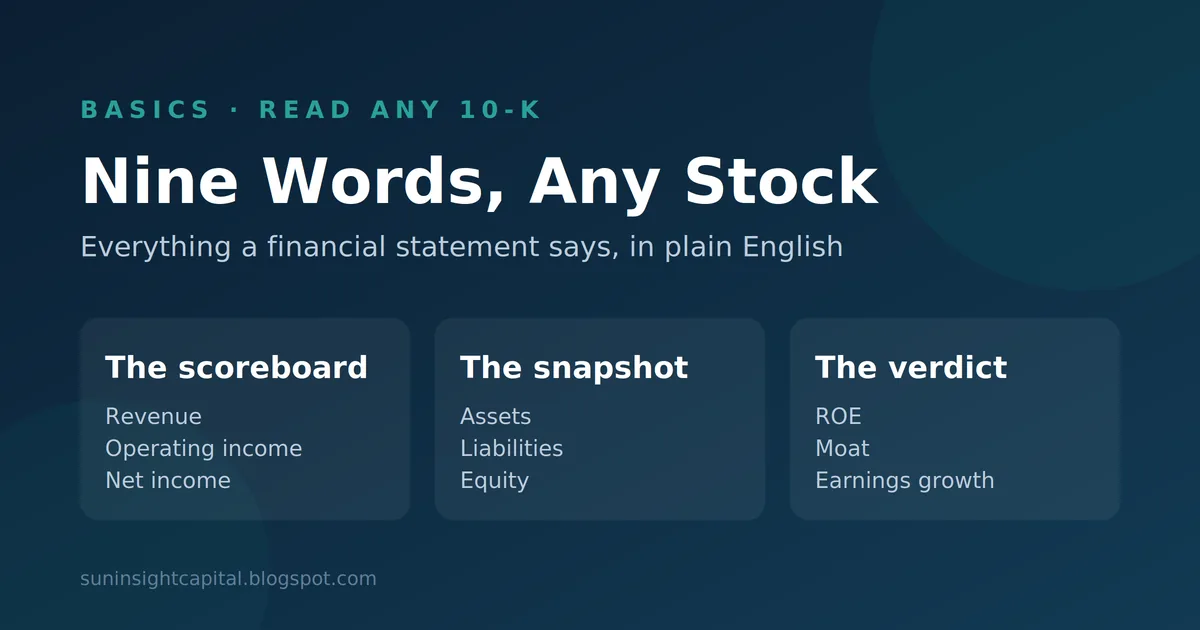
Nine terms for reading financial statements
"Financial statements are too hard" is the most expensive sentence in investing. In truth, everything a beginner needs sits in nine plain-English words — and you can learn all nine in one sitting.
After decades of reading annual reports, I can tell you a secret the finance industry rarely volunteers: the intimidating part of a financial statement is the formatting, not the ideas. Underneath the footnotes, a company report answers two childlike questions — how did the year go? and what shape are you in now? — and then a third one that investors add: is this worth owning? Nine words cover all three.
First, Fire Mr. Market
Before the nine words, one piece of mental hygiene from Benjamin Graham. Imagine you own a good business, and every single day an excitable partner — call him Mr. Market — bangs on your door shouting a price at which he'll buy you out or sell you more. Some days his price is absurdly high, some days insultingly low, and he takes no offense when ignored. Beginners lose money because they stare at Mr. Market's mood instead of the business itself. A falling quote is not information about the company; it is information about the crowd. Everything that follows is about the company — which is where your attention should live.
The Scoreboard: Revenue, Operating Income, Net Income
The income statement is the year's scoreboard, and it's a story of subtraction. Revenue (word one) is the top: everything customers paid for the products and services the company sold. Every business on Earth — a carmaker, a software firm, the coffee shop on your corner — starts here.
Then the line of people with their hands out forms. The steel supplier reminds the carmaker that no steel means no cars. The ad agency wants its fee, the landlord wants rent, employees want salaries. Strip out the costs of actually running the core business and you get operating income (word two): profit from the thing the company is actually in business to do. The distinction matters. If an automaker's venture stake in a robotics startup doubles, that's a gain — but it isn't operating income, because it tells you nothing about whether the car business works.
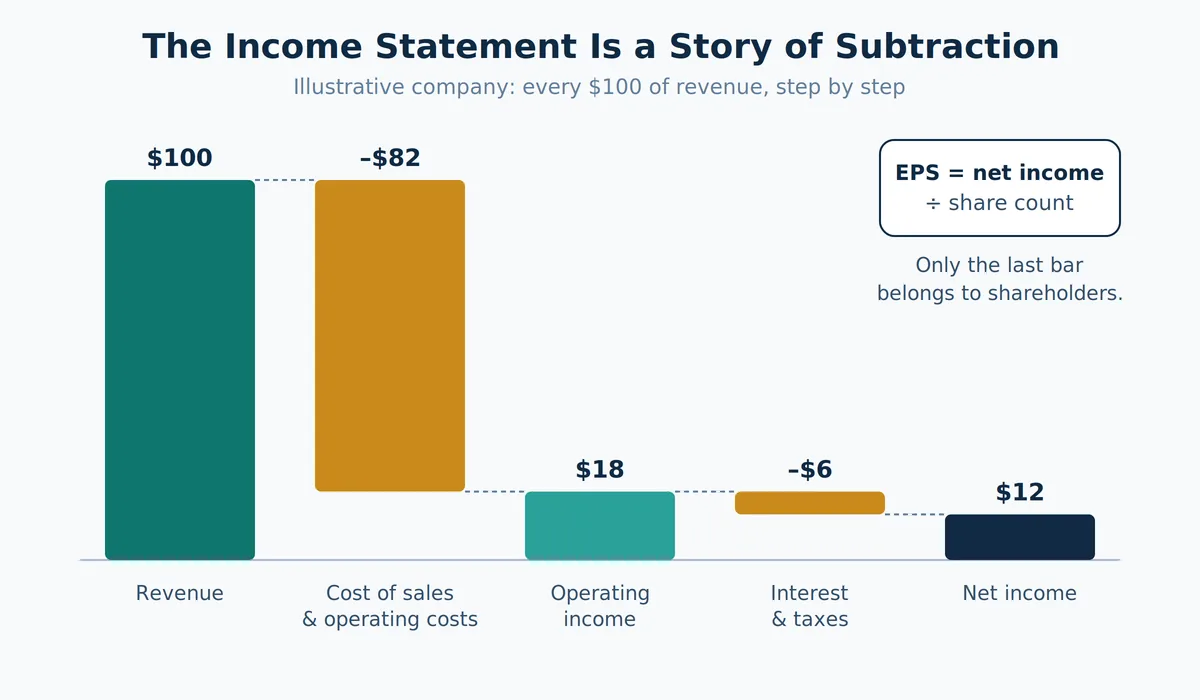
Last in line stand the bank (interest) and the government (taxes). After everyone has been paid, what remains is net income (word three) — and this number deserves your special attention for one reason: it is the only line that belongs to you. Suppliers, employees, lenders and tax authorities all get paid ahead of shareholders. A company with huge revenue and no net income is a worker with a big salary and a bigger credit-card bill — impressive motion, nothing kept. Divide net income by the share count and you get EPS, earnings per share: your personal slice, and the number most professional analysis is built on.
The Snapshot: Assets, Liabilities, Equity
The income statement covers a period — this year's episode. The balance sheet is a photograph: pause the story, what shape is the company in right now? It has exactly three parts. Assets (word four) are resources expected to produce future profit: factories, patents, software, cash, brands. Liabilities (word five) answer "how much of this was funded with other people's money?" And equity (word six) — also called net assets or book value — is what's left after debts: assets minus liabilities, the part that truly belongs to shareholders.
Here's the connection beginners miss, and it's elegant: each year's net income, if not paid out as dividends, flows into equity. The scoreboard feeds the snapshot. A company that earns well year after year builds an ever-thicker cushion of its own capital — which sets up the most important word of all.
The Bridge: ROE
In a hypothetical comparison, two shops each earn $100,000. One has $1 million of equity and the other $100,000. Their simple returns on that equity are 10% and 100%. Before interpreting the difference, check leverage, whether equity is measured consistently, and whether the earnings recur.
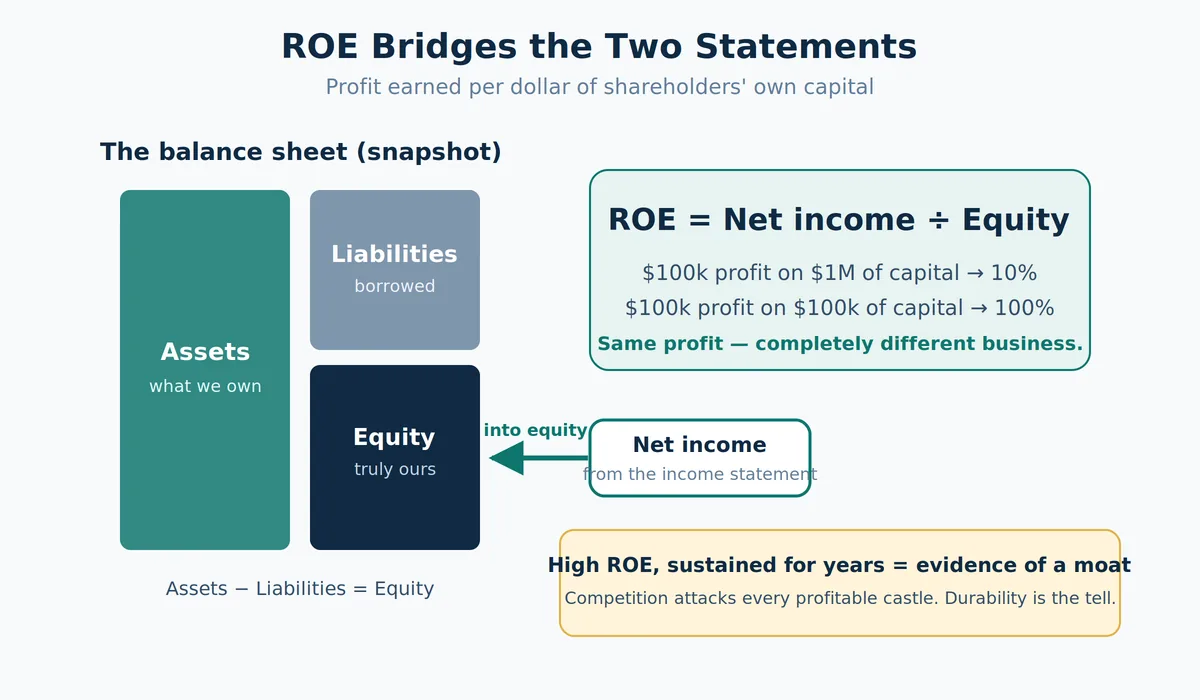
Return on equity compares net income with shareholders’ equity, often averaged over the period. A small or negative equity base, debt, and buybacks can distort it. ROE alone cannot establish business quality or a sensible purchase price. The SEC financial-statement guide explains the statements from which the inputs come.
The Castle Wall: Moat
A high ROE creates a problem: it attracts attackers. In capitalism, anyone is allowed to copy a profitable idea and undercut it — that competition is a feature of the system, not a bug. So the durable question isn't "is ROE high?" but "why hasn't competition dragged it down yet?" Buffett's answer is word eight: the moat — the water-filled trench around a medieval castle, translated into business. Brands people won't switch from, networks that grow more useful with each user, costs rivals can't match, switching costs that lock customers in. You could debate moats for weeks, but there's a practical shortcut: a company that has sustained a high ROE for many years, through competition, has demonstrated a moat by that very fact. The number is the evidence; the moat is the explanation.
The Engine: Earnings Growth
Word nine is the one that ultimately moves stock prices: earnings growth. Look back at any market leader of the past century and beneath the story you'll find the same engine — net income rising, fast, often faster than anyone expected. Narratives, themes and viral tickers come and go, but here is the irony the meme era keeps proving: the most contagious story in markets is a number. "Profits doubled" spreads further than any slogan, because it needs no explanation. Dividends and buybacks — everything a shareholder is eventually paid — can only come out of earnings that exist. When you screen a stock, the last question is always: is the owner's line growing, and how fast?
| # | Word | The question it answers |
|---|---|---|
| 1 | Revenue | How much did customers pay us this year? |
| 2 | Operating income | Did the core business itself make money? |
| 3 | Net income | After everyone was paid, what belongs to shareholders? |
| 4 | Assets | What resources will produce future profit? |
| 5 | Liabilities | How much was funded with other people's money? |
| 6 | Equity | What's truly ours after debts? |
| 7 | ROE | How efficiently does our capital become profit? |
| 8 | Moat | Why can't competitors take this away? |
| 9 | Earnings growth | Is the shareholders' line getting bigger? |
Putting It Together
Here is the whole discipline in one paragraph. Ignore Mr. Market's daily shouting. Read the scoreboard: revenue at the top, operating income for the core business, net income for what's yours. Read the snapshot: assets, minus liabilities, equals equity. Divide the first statement's bottom line by the second statement's last line to get ROE, ask what moat protects it, and check whether earnings are growing. If you can do that — and honestly enjoy doing it — you have met the entry requirement for owning individual stocks. If it still feels like homework, there is no shame and much wisdom in owning a broad index fund instead: you'll capture the growth of all the moats at once, without needing to find them yourself.
Backtest momentum, market-cap, low-volatility, value and quality strategies across the whole S&P 500 — and see each one's weekly returns — in the free Quant Lab.
Open the Quant Lab →
Disclosure: Educational content only, published August 2026. This is not investment advice or a recommendation to buy or sell any security. Figures used in examples are illustrative. Always read a company's actual filings and verify numbers independently before investing.