Chip Stocks Just Tanked — The Only 3 Signals That Should Make You Sell
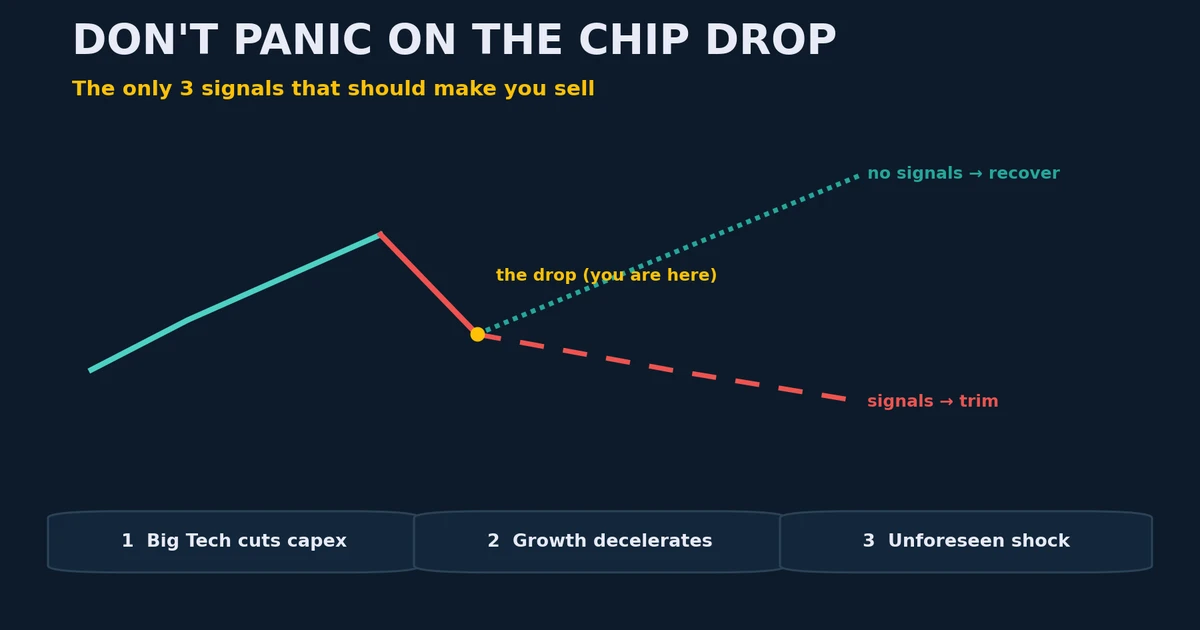
US semiconductor and AI-memory stocks just had a sharp, scary day — NVIDIA, AMD, Broadcom, Micron and the SOXX ETF all fell together, and the headlines made it sound like the AI trade was unravelling. Before you sell, remember the most important rule of a correction: a falling price is not, by itself, a reason to sell. What matters is whether the actual cycle has turned. Here are the three signals that would justify trimming AI/chip exposure — and why, for now, none of them is clearly flashing.
Note: Educational market commentary, not investment advice. US-market focus only. This is a decision framework, not a prediction that the drop will or won't continue.
A drawdown is the price of admission, not an exit signal
Chip stocks are volatile by design. Even inside powerful multi-year runs, names like NVDA and AMD have repeatedly fallen 20–40% and gone on to new highs. Selling every sharp dip is how investors turn normal volatility into permanent loss — locking in the drop, then missing the recovery. Don't ask "how much is it down?" Ask "has the cycle actually broken?" Watch these three things.
Signal 1 — Big Tech stops its AI capex
The whole chip rally is funded by one thing: hyperscaler capital spending. Microsoft, Alphabet, Amazon and Meta pour money into data centers, and it flows downstream into GPUs and memory. If that capex stops, chip profits shrink — so a genuine guidance cut from the hyperscalers would be the cleanest sell signal there is.
But right now the spending is accelerating, not stopping. Alphabet has guided 2026 capex to roughly $180–190 billion — about double 2025; Amazon is near $200 billion, with Microsoft and Meta each above $100 billion. The tell that they're not backing off: in June 2026 Alphabet priced an ~$84.75 billion equity raise — the largest in history — including a $10 billion anchor stake from Berkshire Hathaway, and reversed years of buybacks, specifically to fund AI infrastructure because it is "compute constrained." When a cash machine sells new stock rather than cut spending, the money pipeline into chips isn't closing soon.
| Watch for (real signal) | Reassuring counter-signal (now) |
|---|---|
| Hyperscalers guiding capex down; order cancellations; inventory glut | Capex still rising; companies raising capital to spend more |
Signal 2 — Earnings growth decelerates (not declines)
The trigger isn't profits falling — almost no one expects that yet. It's the growth rate slowing. Chip and memory earnings have grown explosively off a low base; the question is the second derivative: when year-over-year growth is still positive but clearly decelerating quarter after quarter, the easy money is behind you and the multiple has less room to expand. Pricing and product-mix shifts (for example, demand swinging between high-end and commodity memory) can surprise in either direction, so watch the trend in estimates, not a single print.
Signal 3 — An unforeseen shock, with the chip price as the canary
The first two are knowable. The real risk is the one nobody is modeling: NVIDIA's next-generation chips (Blackwell, GB300, the Rubin line) stumbling; a US–China flare-up disrupting Taiwan's supply chain; substrate or optical bottlenecks; or — paradoxically — AI efficiency improving so fast that the world needs less memory than expected.
Here's the key: semiconductors are the market's canary in the coal mine. They sit at the end of the supply chain, where the bullwhip effect amplifies small changes in end demand into big swings in chip orders — so chip stocks often move first. If the group falls hard while the fundamentals still look pristine, don't dismiss it. The price may be pricing in something you can't see yet. That's a reason to pay attention, not necessarily to sell — but it's the signal that has historically led.
What to do during the drop instead of panic-selling
| Do | Avoid |
|---|---|
| Re-check the capex pipeline and estimate trend | Selling purely because the number is red |
| Right-size any one chip name (position sizing) | Doubling down with money you'll need soon |
| Decide your sell rules in advance | Inventing rules mid-panic |
| Separate a tradeable dip from a broken cycle | Confusing a 30% drop with a thesis change |
Get perspective from history: open the simulator, put NVDA, AMD, MU and SOXX in Compare mode over a long window, and count how many sharp drawdowns happened inside the larger uptrend. Seeing past dips in dollar terms makes today's move feel less unique.
Until Big Tech's capex turns down, earnings growth clearly decelerates, or an unforeseen shock shows up in the price first, a chip-stock drop is usually a test of patience — not a signal to sell. The long-term driver (AI infrastructure demand) is, if anything, getting bigger.