NVIDIA at $5 Trillion: A Plain-English Deep Dive Into the Buy-or-Sell Debate
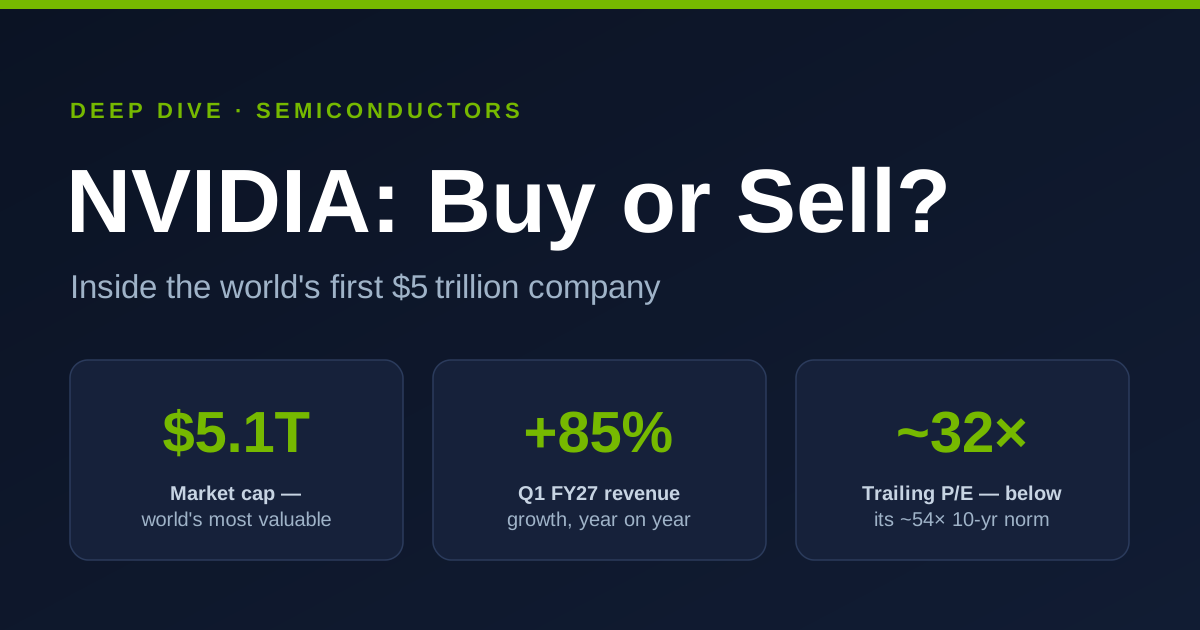
In late 2025 NVIDIA did something no company had ever done: it crossed a $5 trillion market value. By mid-June 2026 it was still the most valuable company on Earth, worth roughly $5.1 trillion with the stock around $211. And here is the part that makes the “is it a bubble?” conversation more interesting than it looks: despite that staggering size, NVIDIA's trailing price-to-earnings ratio sat near 32 — below its own ten-year average of roughly 54. The stock got enormous, but the earnings grew even faster. That single tension is the whole buy-or-sell debate in miniature, and it's worth slowing down to understand properly.
Note: Educational deep dive, not investment advice or a recommendation. Figures are drawn from NVIDIA's fiscal 2026 results, its Q1 fiscal 2027 report (reported May 2026), and public market data as of mid-June 2026; they move constantly — verify before relying on any number.
First, what does NVIDIA actually sell now?
Most people still picture NVIDIA as a maker of graphics cards for gamers. That's where it started, but it is not the business anymore. Today NVIDIA sells complete AI computers — and increasingly, whole data-center rooms. A modern order isn't “a chip.” It's a rack that bundles together GPUs (the parallel-math engines), CPUs (NVIDIA's own Grace processors), the networking that lashes thousands of chips into one machine, and the software layer that makes all of it usable.
That last piece — software — is the part outsiders consistently underrate. NVIDIA's CUDA platform is the language a huge share of the world's AI researchers already write in. Fifteen-plus years of libraries, tools, and trained engineers are built on top of it. A rival can match a chip's raw specs and still lose, because the customer would have to rewrite their entire software stack to switch. Gaming, once the whole company, is now a rounding error next to this.
The numbers, in one place
NVIDIA's fiscal year is offset from the calendar — fiscal 2026 ended in late January 2026. Here's the headline picture for the full year and the two most recent quarters.
| Metric | FY2026 (full year) | Q4 FY2026 | Q1 FY2027 (latest) |
|---|---|---|---|
| Total revenue | $215.9B (+65% YoY) | $68.1B (+73% YoY) | $81.6B (+85% YoY) |
| Data Center revenue | $193.7B (+68%) | $62.3B | $75.2B (+92%) |
| Gross margin | 71.1% (GAAP) | 75.0% | ~75% range |
| Earnings per share | $4.90 (GAAP, FY) | — | $1.87 (adj., +131% YoY) |
| Free cash flow | — | ~$35B | $49B |
A few things deserve emphasis. Revenue of $81.6 billion in a single quarter is the largest quarter in semiconductor history. Data Center alone was $75.2 billion of that, up 92% from a year earlier. Gross margins near 75% are extraordinary for a hardware company — it means that for every dollar of product sold, about 75 cents is gross profit, a level usually reserved for software. And the company is now returning serious cash: it announced an $80 billion buyback authorization and raised its dividend from a token $0.01 to $0.25 a quarter.
Where the money comes from
The story is overwhelmingly one segment — but the shape inside that segment is changing in ways worth watching. In its latest quarter NVIDIA started reporting Data Center as roughly half “hyperscale” (the big cloud builders) and half everything else (AI clouds, enterprise, sovereign governments, industrial). The fastest-growing slice is networking.
| Business line (Q1 FY2027) | Revenue | Growth (YoY) | What it is |
|---|---|---|---|
| Data Center — compute | $60.4B | +77% | GPUs & AI accelerators (the core engine) |
| Data Center — networking | $14.8B | +199% | InfiniBand, Spectrum-X Ethernet, NVLink |
| Gaming & edge / workstation | $6.4B | +29% | GeForce, pro visualization, robotics |
Notice the networking line tripling. That is not a side business — it's the moat hiding in plain sight. When a customer wants to wire 100,000 chips into a single training machine, the connective tissue between the chips matters as much as the chips. NVIDIA bought its way into that market years ago (the Mellanox acquisition) and now sells the GPUs and the wiring and the software, as one system. That bundling is exactly why competitors find it so hard to peel customers away one component at a time.
The moat, in one table
“Moat” is just a word for why a business can keep its profits instead of competing them away. NVIDIA's comes from four reinforcing sources.
| Moat source | Why it's durable |
|---|---|
| CUDA software | A 15+ year ecosystem most AI code is written in. Switching means rewriting your stack — a cost few will pay. |
| Systems & networking | NVIDIA sells whole racks, not parts. Owning the GPU, CPU and the network makes the bundle hard to unpick. |
| Annual cadence | A new platform roughly every year (Hopper → Blackwell → the coming Vera Rubin), forcing rivals to chase a moving target. |
| Scale & cash | ~75% gross margins and tens of billions in quarterly free cash flow fund R&D no challenger can match. |
On that cadence: management has already teased the next platform, Vera Rubin, as a rack-scale system it claims delivers roughly 10× the performance-per-watt of today's Grace Blackwell. Whether or not that exact figure holds, the strategic point is the tempo — NVIDIA resets the bar every year, which keeps would-be competitors perpetually a step behind.
The bull case
Strip away the noise and the optimistic argument is simple and, importantly, grounded in things that are already happening rather than just hoped for.
| Bull argument | The evidence behind it |
|---|---|
| Demand still outruns supply | Record $81.6B quarter, guidance to ~$91B next quarter, “fastest product ramp in company history.” |
| Earnings growing faster than the stock | Adjusted EPS +131% YoY, which is why the P/E fell even as the price rose. |
| The moat is widening, not narrowing | Networking +199%; software lock-in deepening; annual platform cadence. |
| Real profits, real cash | ~75% gross margin, $49B quarterly free cash flow, $80B buyback, a new dividend. |
The bear case
An honest deep dive spends at least as long on what could go wrong. None of these are reasons NVIDIA “must” fall — they're the genuine risks a buyer is taking on.
| Bear argument | Why it matters |
|---|---|
| Customer concentration | Roughly half of Data Center revenue comes from a handful of hyperscalers. If even one slows its buildout, the number moves hard. |
| China / export limits | NVIDIA took a ~$4.5B charge on H20 inventory and now guides assuming zero China data-center compute revenue — a market it used to serve. |
| Customers building their own chips | Google (TPU), Amazon (Trainium), and others are designing in-house accelerators to reduce reliance on NVIDIA. AMD's Instinct line is also improving. |
| The “digestion” risk | Chips are cyclical. After a historic buildout, a pause to absorb capacity could turn blistering growth into a temporary air pocket. |
| Expectations are sky-high | The stock fell ~5% the day after its record quarter. When perfection is priced in, even great results can disappoint. |
That last row is the one casual investors miss most often. NVIDIA can post the best quarter in the history of its industry and still drop, because price reflects expectations, not just results. “Good” isn't enough when the market already assumed “great.”
Is it expensive? Valuation in context
This is where the opening tension resolves into numbers. By the usual yardsticks, NVIDIA is not priced like a cheap stock — but relative to its own history and its growth, it is nowhere near its most extreme.
| Valuation measure (mid-June 2026) | Reading | Plain meaning |
|---|---|---|
| Trailing P/E | ~32× | Below its ~54× ten-year average — cheaper than its own norm. |
| Forward P/E | ~21× | If estimates hold, the multiple compresses further as earnings grow. |
| PEG ratio | ~0.5 | P/E set against its growth rate; under 1 is often read as “growth not fully priced.” |
| Analyst consensus | “Strong Buy,” ~$299 target | The Street still sees upside — but targets are opinions, not facts. |
The honest read: a trailing P/E of 32 on a company growing earnings ~100% a year is not, by itself, a bubble valuation — it has been far more expensive in the past. The risk in the price isn't the multiple today; it's the assumption baked into it that hyper-growth continues. If it does, the stock can look cheap in hindsight. If the buildout pauses, that same multiple has room to fall even if the company stays excellent.
So — buy or sell? A framework, not an answer
We don't give recommendations, and the truthful answer to “buy or sell?” is “that depends on you, not on NVIDIA.” But you can replace a gut reaction with a checklist. The buy-or-sell question really decomposes into four smaller, answerable ones:
| Ask yourself… | Leans buy if… | Leans wait/trim if… |
|---|---|---|
| Is the demand real and durable? | Backlog and guidance keep rising | Hyperscaler capex plans flatten or get cut |
| Is the moat intact? | CUDA + networking lead holds | Custom chips/AMD take real share |
| Is the price sane for the growth? | P/E reasonable vs. growth (PEG < 1) | Multiple re-inflates far above earnings |
| Does it fit your plan? | Position size you can hold through a 30%+ drop | You'd be forced to sell in a panic |
That fourth row tends to decide more outcomes than the first three. A great company held at the wrong position size still produces a bad investor experience, because volatility forces a sale at the worst moment. NVIDIA has fallen 30%+ several times during its historic run. Owning it has always meant stomaching that.
Test the idea instead of guessing: in the simulator, run NVDA against the broad S&P 500 in Compare mode over a few different start dates — including one that begins right before a past drawdown — to feel what the ride actually looked like. Or see how a rules-based momentum or top-market-cap strategy would have held it in the Quant Lab.
Key takeaways
NVIDIA is no longer a chip company so much as an AI systems company — GPUs, CPUs, networking and the CUDA software, sold as one machine. The financials are genuinely exceptional: a record $81.6 billion quarter, ~75% gross margins, and free cash flow large enough to fund an $80 billion buyback and a new dividend. The moat — software lock-in, systems bundling, an annual platform cadence, and unmatchable scale — is widening, not shrinking. And counter-intuitively, the valuation is below its own historical norm because earnings have outrun the share price. The real risks are concentration in a few customers, the loss of the China market, customers designing their own chips, the cyclical “digestion” danger, and expectations so high that even a record quarter can disappoint. The buy-or-sell decision isn't really about whether NVIDIA is a good company — it plainly is — but about whether the durable demand continues, the moat holds, the price stays sane for the growth, and the position fits a plan you can actually hold through the next drawdown.
This article is for educational purposes only and does not constitute investment advice or a recommendation to buy or sell any security. NVIDIA (NVDA) is a publicly listed company; all investment decisions carry risk. Figures reflect NVIDIA's fiscal 2026 results, its Q1 fiscal 2027 report, and public market data as of mid-June 2026, and will change over time. Verify independently before relying on any figure.
Back to Deep Dives | Return to the Quant Lab | Open the Simulator