The Two Yields That Just Rattled Every Stock Portfolio — Here's What's Coming Next
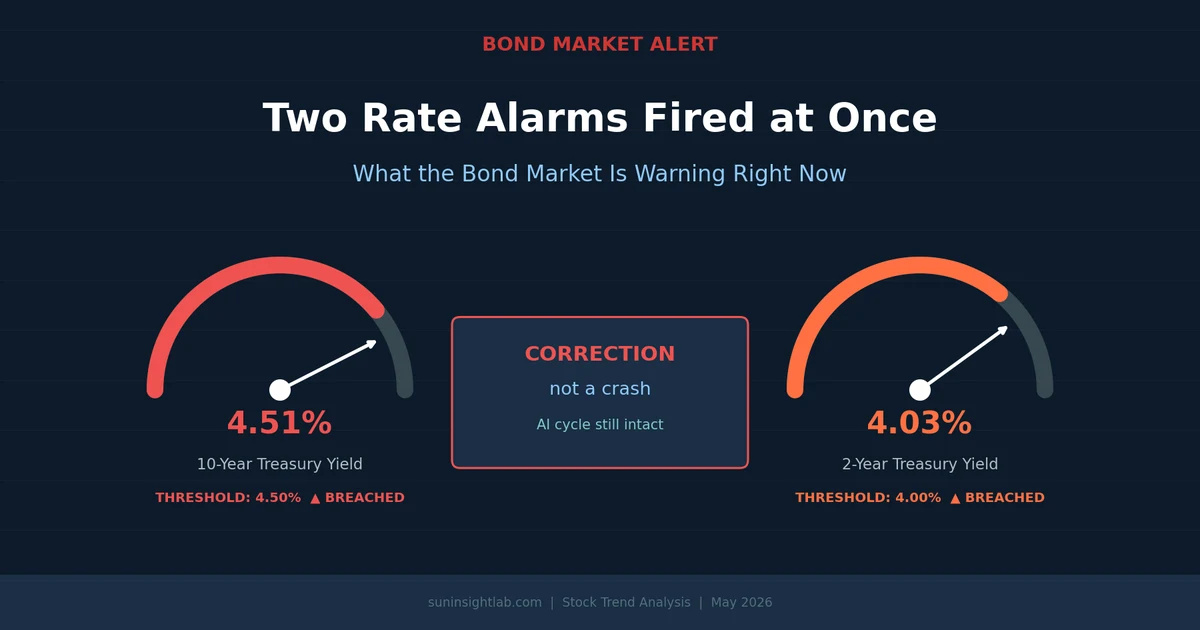
Global equity markets pulled back sharply on May 15–16, 2026, as two widely-watched interest rate thresholds were both breached on the same day: the U.S. 10-year Treasury yield broke above 4.5% and the 2-year yield rose above 4.0%. These levels had been highlighted by many analysts as the line between "manageable" and "market-rattling," and crossing them together gave the stock market reason to pause.
Correction, Not a Crash
The word "correction" is worth unpacking. A correction simply means the market has risen faster than its underlying trend justifies, and price pulls back toward where it "should" be. It is not the end of a bull run — it is a normal part of one. Think of it as the market catching its breath: prices rise, overshoot slightly, correct back, then resume climbing. This is different from a bear market or a structural breakdown.
The longer-term AI-driven bull thesis that has powered equities through 2024–2026 remains intact. The AI investment cycle has not changed overnight. What has changed is the cost of money sitting alongside it, and that friction is what triggered the pullback.
Why Rates Matter Right Now
For most of the past year, interest rates moved around within a predictable range. When rates trade in a box, equity investors largely ignore them. The trouble comes when rates break out of that box — as they did this week — because it signals that the environment has genuinely shifted. Three forces combined to push yields higher.
First, U.S. economic data came in stronger than expected. A resilient economy reduces the urgency for the Federal Reserve to cut rates, so markets repriced the rate-cut timeline significantly. As of mid-May 2026, the probability of any Fed rate cut during 2026 has effectively fallen to near zero. More strikingly, markets are now beginning to price in the possibility of a rate increase sometime in 2027 — a scenario that was almost unthinkable just a month ago.
Second, a new Fed Chair recently took office. Bond markets sometimes "test" incoming Fed leadership — pushing rates higher to see how the new chair responds — and that dynamic may be adding upward pressure beyond what pure economic data would justify.
Third, global bond yields are rising in unison. Japan's long-term yields also reached new highs this week, and many developed-market bonds are approaching or threatening their 2023 peaks. When multiple bond markets move together, it amplifies the message: the world may simply be settling into a higher-for-longer interest rate era.
What Else Moved
The rate shock rippled across asset classes. Oil prices edged higher — the summer driving season is approaching, and diplomatic progress on Iran supply remains stalled — adding an inflationary undertone to an already jumpy market. A stronger dollar accompanied the rate rise. Gold and Bitcoin, which had both benefited from dollar weakness earlier in the year, fell in tandem with equities.
Semiconductor and high-growth technology stocks, which are most sensitive to discount rates, saw the sharpest declines. These are the same names that led the AI rally, so the pullback there was proportionally larger.
Echoes of 2022 — and Why This Is Different
It is natural to ask whether this is 2022 repeating itself. In 2022, rapidly rising rates drove a prolonged bear market because rates were entering new territory from near-zero. This time, rates are moving in a market that has already spent two years adapting to a 4–5% yield environment. The question is not whether higher rates hurt growth stocks — they do — but whether the move is large enough and sustained enough to derail the broader economic expansion. That answer is not yet clear.
If yields stabilize and pull back from these levels, the correction may prove brief and shallow. If they continue to climb into new territory, the uncertainty period lengthens. Both outcomes remain possible. Historically, the investment adage attributed to Howard Marks captures the right posture: rather than predicting exactly what will happen, focus on being prepared to respond to whatever does.
How to Think About Your Portfolio
A correction is not a reason to exit the market entirely, but it is a reasonable prompt to review your exposure. A few questions worth asking: Has your equity allocation grown significantly above your target because of recent gains? If so, a correction is a natural moment to trim back toward your plan — not out of fear, but as disciplined rebalancing. Do you hold positions sized for a low-volatility environment that may feel uncomfortable if the pullback deepens? Corrections are also good stress-tests of position sizing.
On the other hand, if you are a long-term investor with a multi-year horizon and a diversified portfolio, doing nothing is often the right answer. Selling into a correction locks in losses and introduces the harder problem of timing re-entry. The people who tend to regret corrections most are those who sold near the bottom and then missed the recovery.
For investors curious about how various assets have historically performed through interest-rate cycles, our Stock Investment Simulator lets you backtest any time period with real monthly price data. Zooming out to include periods like 2022 can give a concrete sense of what a sustained rate-driven pullback actually looked like in dollar terms.
Key Takeaways
The 10-year Treasury yield breaking above 4.5% and the 2-year above 4.0% simultaneously was a meaningful signal, not background noise. A correction in equities is now underway. It is best understood as a pause within a broader uptrend powered by the AI investment cycle, not as the beginning of a structural bear market — though that assessment can change if rates continue to climb. Oil prices and global bond yields are worth watching as leading indicators. The appropriate investor response is to review position sizing and rebalancing needs, not to panic.
Markets will need time — likely measured in weeks rather than days — to adjust to the new rate reality. That adjustment period is uncomfortable, but it is also a normal feature of any sustained bull market.
This article is for educational purposes only and does not constitute investment advice. Past performance is not indicative of future results.